

“The staff we had onsite were amazing. They were polite, professional, and always willing to help. They made a meaningful impact on the success of our event.”
Carrie M. · Senior Project Manager, eventPower
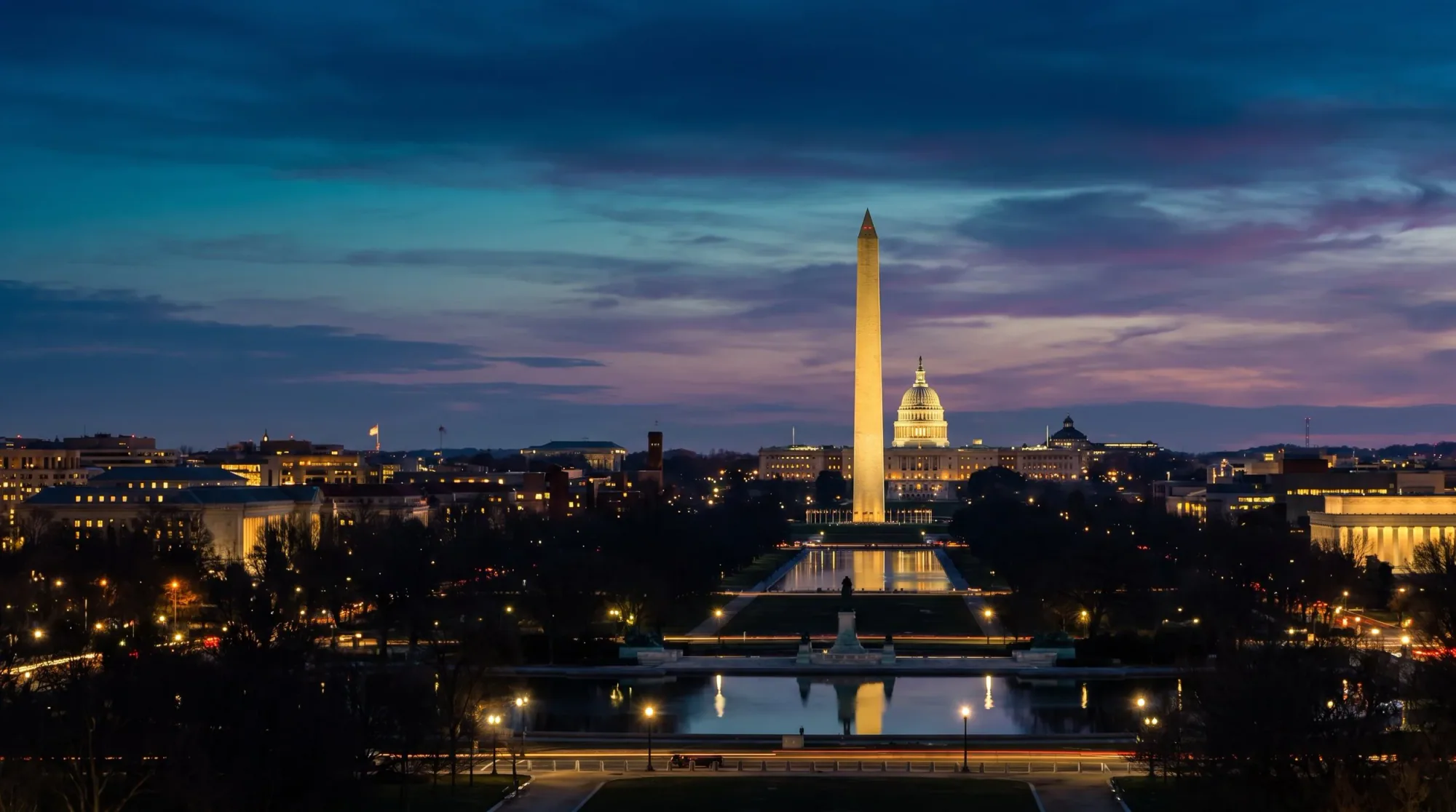
TempGuru · Washington, DC · Local planning guide
Crews for the association, summit, and inaugural calendar that fills the nation's capital, cleared through background checks and badging before they reach a secured floor.
Scroll. It gets specific.01The Ground Truth
National associations hold their annual meetings here, advocacy groups run fly-ins on the Hill, and policy shops pack the Walter E. Washington Convention Center with summits and forums. Filling the seats is the easy part. The work is moving a vetted, badge-cleared crew past the magnetometers and onto a secured floor before the first session, and the federal-adjacent dates push that clearance bar higher than almost any other market.
The Walter E. Washington Convention Center totals 2.3 million square feet, with 703,000 square feet of exhibit space (473,000 square feet contiguous), per Events DC's own fact sheet. That contiguous block is the largest in the Mid-Atlantic region.
02The Map
The map is small and the security is not. Downtown, in Penn Quarter, holds the Walter E. Washington Convention Center, with Capital One Arena a short walk away, so an association general session and an arena crowd can land the same evening off one Metro platform. Southwest, along the Washington Channel, The Wharf keeps its own schedule around The Anthem. Down on the Anacostia, Navy Yard puts Nationals Park and, a few minutes over at Buzzard Point, Audi Field into the same southeastern pocket of the city.
Getting there is rarely the problem. The Metro reaches every one of these venues, and nothing here is a highway haul. Access is. A federal-adjacent event runs credentialed entry, magnetometer screening, and a bag-check line, while a motorcade, a demonstration, or a Secret Service perimeter can shut a block on short notice and rewrite the load-in window. So the call sheet is planned backward from the screening queue and the closure map, and every worker on it has cleared a background check before showing up.
"The venues here sit minutes apart. What sets the call time is the badge line and the security perimeter, never the drive."Local planning note
Walter E. Washington Convention Center, Penn Quarter. More than two million square feet of association and trade-show floor. Freight moves through the loading docks early, and the registration and floor teams stage to the badge-issuance window rather than the clock on the wall.
Capital One Arena, Penn Quarter. A downtown arena steps from the Convention Center. Event gates screen with magnetometers and bag checks, so plan a screening cushion ahead of the crowd and post crew off the Metro instead of a garage.
Nationals Park and Audi Field, the Anacostia waterfront. Baseball at Navy Yard, soccer a few minutes over at Buzzard Point, close enough to share a night. Both sit behind controlled lots and event-day street closures, so send crew down the Green Line before first pitch and kickoff, not into the road grid.
The Anthem, The Wharf. A Southwest Waterfront concert hall with a tight load path off the promenade. Late calls, a packed Wharf, and almost no on-site parking keep the crew on transit and on early report times.
03What We Staff
Line up a year of D.C. bookings and the association world sits on top. Conventions, trade shows, and advocacy fly-ins take the Convention Center's busiest weeks and spill into hotel ballrooms across downtown, each one wanting badge desks, floor teams, and freight hands. Galas and policy summits follow close behind, the black-tie dinners, award nights, and think-tank forums that live or die on a check-in line, a coat room, and a floor read right.
After that the calendar turns local. Arena sports and concerts at Capital One Arena, Nationals Park, and Audi Field bring the scanner crews, ushers, and entry lines a sold gate depends on. Government and contractor events handle the receptions, briefings, and awards for the agencies and firms based here, and brand activations put trained ambassadors on the National Mall or along The Wharf.
06The Rate
Published Washington role rows are planning inputs, not a quote. Accepted terms control duties, the minimum shift, rate, and approved charges.
| Role | Rate | Min shift |
|---|---|---|
| General labor / setup | $33–$39/hr | 4 hrs |
| Registration | $33–$39/hr | 4 hrs |
| Warehouse / logistics | $33–$39/hr | 4 hrs |
| Crowd control / ushers | $33–$39/hr | 4 hrs |
| Team leads / supervisors | $43–$49/hr | 4 hrs |
| Specialized (bar, AV, ambassadors) | $49.50–$69.50/hr | 4 hrs |
| Concessions staff | $33–$39/hr | 4 hrs |
| Hospitality & bar staff | $49.50–$69.50/hr | 4 hrs |
| Merchandise staff | $33–$39/hr | 4 hrs |
| Parking & traffic staff | $33–$39/hr | 4 hrs |
| Ushers & guest services | $33–$39/hr | 4 hrs |
09A Sample Plan
This illustrative scenario, not a historical TempGuru order, models International affairs summit at Walter E. Washington Convention Center in Washington, DC, 5,000 planned attendees, over 3 days. The planning roster totals 33 workers across 11 General labor / load-in, 9 Registration / credential desk, 6 Screening line, 4 Wayfinding & doors, 3 Team leads.
33 billable, staggered by arrival window: 11 handle setup and load-in, 9 handle registration, and 3 leads oversee about 10 each. No one clocks in before there's work to do.
Freight at the convention center is not one loading line. Halls A/B/C dock at 7th and M Street NW while Halls D/E dock at 9th and M Street NW, with one freight door per exhibit hall for both freight and personnel. Early-call crews on a split-hall show need their entrance assigned before call time, not after.
Capital One Arena runs 20,356 for Wizards (NBA) games and 18,506 for Capitals (NHL) games in downtown Penn Quarter. Every event uses walk-through magnetometers plus a strict no-bag policy, with a 5-by-7-inch clutch as the only exception, so arrival call times need a screening-lane buffer, not just a door-open buffer.
Capital One Arena is mid-renovation on an $800 million, six-phase project that started December 2024 and finishes in time for the 2027-28 season. The building stays open through NBA and NHL season but closes for major construction in summer months, including summer 2026, so any summer booking there needs to be confirmed as a live event, not a closure-window conflict.
Nationals Park seats 41,565 in the Navy Yard/Capitol Riverfront corridor of Southeast DC, just south of the Capitol. The call sheet should use the booked gate, arrival route, and event-specific attendance rather than capacity alone.
Audi Field seats 20,000 in the Buzzard Point section of Ward 6, Southwest DC, per the District's own economic development office. It sits on the same Anacostia riverfront stretch as Nationals Park's Navy Yard site, so a DC United match and a Nationals home game on the same night can pull from the same access roads and rideshare drop zones. Staffing plans should treat that as one shared-logistics zone, not two isolated calls.





Event-format planning in Washington
These guides apply the Washington market context to the roles, shift phases, access points, and handoffs that change by event format.
Local operating notes for each published role guide, with rates, team-size inputs, and planning details for Washington events.
Review Concessions Staff in Washington. Baseball at Navy Yard, soccer a few minutes over at Buzzard Point, close enough to share a night. Use that operating detail to scope the concessions crew call.
Review Crowd Control Staff in Washington. Event gates screen with magnetometers and bag checks, so plan a screening cushion ahead of the crowd and post crew off the Metro instead of a garage. Use that operating detail to scope the crowd-control crew call.
Review Setup & General Labor in Washington. Freight moves through the loading docks early, and the registration and floor teams stage to the badge-issuance window rather than the clock on the wall. Use that operating detail to scope the setup and general-labor crew call.
Review Hospitality & Bar Staff in Washington. Late calls, a packed Wharf, and almost no on-site parking keep the crew on transit and on early report times. Use that operating detail to scope the hospitality and bar crew call.
Review Merchandise Staff in Washington. Event gates screen with magnetometers and bag checks, so plan a screening cushion ahead of the crowd and post crew off the Metro instead of a garage. Use that operating detail to scope the merchandise crew call.
Review Parking & Traffic Staff in Washington. Both sit behind controlled lots and event-day street closures, so send crew down the Green Line before first pitch and kickoff, not into the road grid. Use that operating detail to scope the parking and traffic crew call.
Review Ushers & Guest Services in Washington. More than two million square feet of association and trade-show floor. Use that operating detail to scope the usher and guest-services crew call.