
Evidence-led event staffing guide · How To Staff
How to Staff a Stadium Event
Plan stadium event staffing by access zone, fixed post, operating period, role boundary, venue requirement, and local market rate—not an unsupported crowd-size formula.
Quick answer
Staff a stadium event by dividing the building and exterior into operating zones, inventorying every required post, assigning qualified providers to regulated functions, and scheduling temporary guest-service and operations roles around load-in, gates, bowl activity, egress, and reset.
- Core method
- Zones + posts
- Planning
- 2–4 weeks
- Pricing
- Local by city
Observed assignments
How can complete TempGuru-supplied workforce examples inform a stadium plan?
The reports identify the complete workforce supplied through TempGuru for each listed event, but not venue capacity, attendance, or workers supplied by the venue and other vendors. These assignments are planning analogies for lead structure, language needs, and role separation. They are not evidence of a stadium staffing ratio.
| Assignment | Complete workforce supplied through TempGuru | Planning use |
|---|---|---|
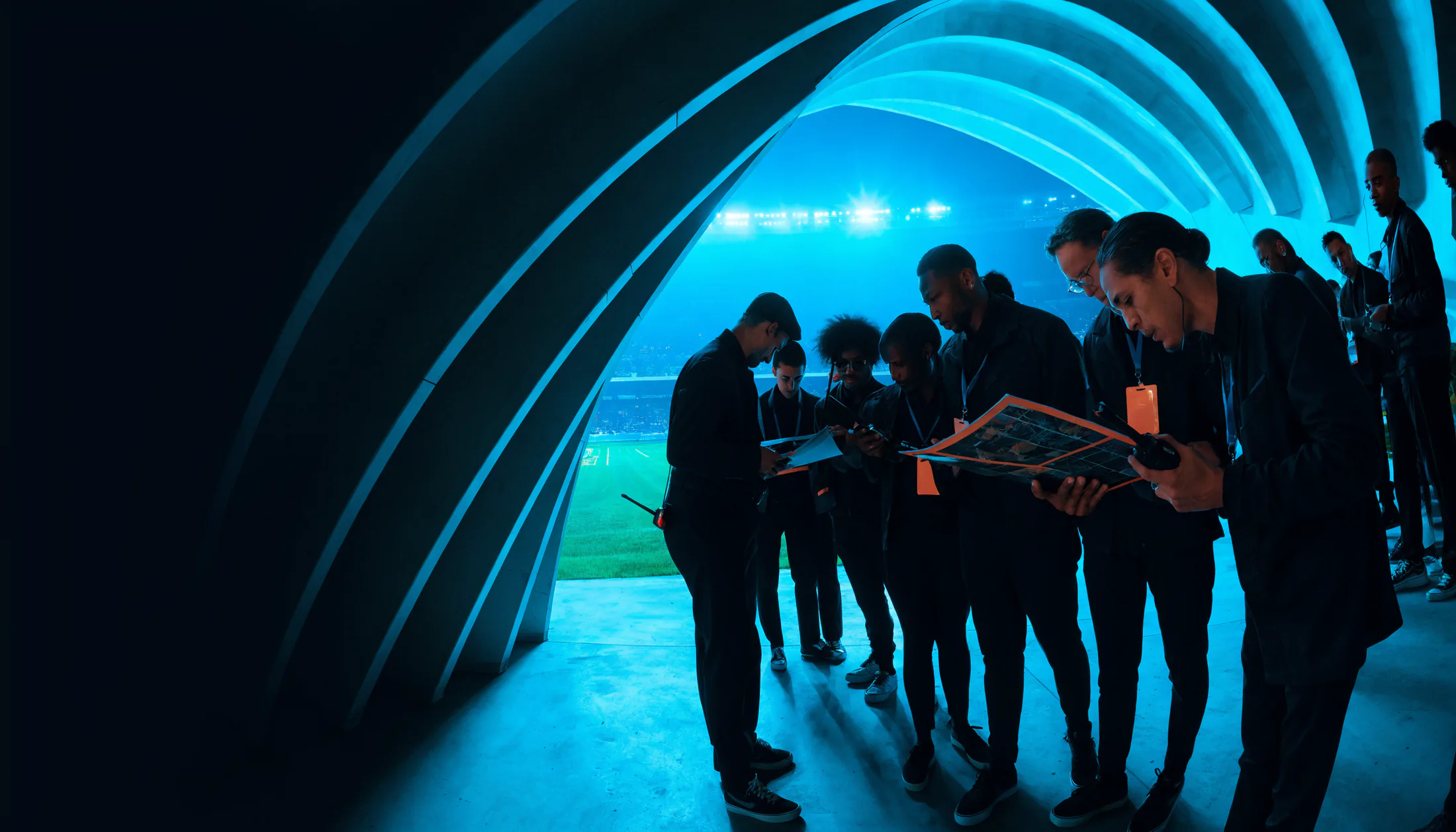
| Soccer Match Setup Frias Agency | 12 leads and 283 staff (295 staff supplied through TempGuru) | The recorded lead-and-staff mix is a prompt to define lead spans, check-in waves, and zones; 295 is neither the event's total workforce nor a staffing benchmark. |
| FIFA World Cup · Kansas City Land Airline | 2 bilingual event leads and 20 bilingual event staff (22 staff supplied through TempGuru) | Language capability is written into the role line. Confirm the proficiency standard and briefing needs before sourcing. |
| Lamborghini Club USA · Monterey Car Week Lamborghini Club USA | 1 event lead, 7 event security, and 12 event staff (20 staff supplied through TempGuru) | The order separates event security from event staff. Confirm qualifications, provider responsibility, and venue approval before treating those roles as interchangeable. |
How to read this: Read each row as one documented TempGuru contribution to a named scope. Megan Hayward confirmed that the listed role quantities are the complete workforce supplied through TempGuru for that assignment. They do not include workers supplied by the venue, client, or other vendors, and they are not attendance totals, venue capacity, or staff-to-attendee ratios. The 295-position soccer setup, 22-person bilingual Kansas City team, and 20-person Monterey mix answer different planning questions; none describes a venue-wide crew. The reports also omit shift concurrency.
Which stadium zones need their own staffing plan?
Quick answer: Plan the exterior, entry, concourse, seating, premium, back-of-house, and exit environments as separate operating areas.
Exterior planning can include parking welcome, pedestrian wayfinding, queue communication, will-call direction, and accessible entrance assistance. Entry planning can include greeters, ticket-support assistants, credential desks, and guest-services posts. The venue determines which functions belong to its security, ticketing, traffic, or medical providers.
Inside, map concourse information, section ushers, elevators, premium check-in, suites, sponsor activations, merchandise support, and accessibility assistance. Back-of-house tasks require their own credential and equipment boundaries. Permanent venue staff, vendors, and temporary event personnel may use different accreditation systems, so confirm the credential, screening queue, entrance, and escort rule for each role. Treat vendor access as a named workstream rather than a show-day note. Egress then reverses the guest flow, so workers need new positions and instructions rather than an assumption that arrival posts still make sense.
How many temporary workers does a stadium event require?
Quick answer: Count posts and shift coverage from the venue operating plan; crowd capacity alone cannot produce a safe number.
Inventory fixed positions first, then add roaming assignments and supervisors. For each post, record opening time, closing condition, break coverage, radio or contact method, and escalation route. Validate the draft with venue operations because entrance configuration, seating areas, premium spaces, event format, and tenant responsibilities differ.
Avoid publishing a generic workers-per-thousand-attendees rule as a requirement. Regulations, permits, and venue standards may set expectations for specialized functions, but those sources must be checked for the actual jurisdiction and event. An adjustable headcount worksheet can organize assumptions without replacing venue review.
Which stadium roles require special qualification or venue approval?
Quick answer: Security, medical, alcohol, traffic, equipment, and technical work may require credentials or a designated provider.
A temporary staffing request should not blur those responsibilities into generic event staff. The venue and event owner should identify the authorized provider for bag screening, emergency response, crowd management authority, traffic control, alcohol service, forklift operation, rigging, electrical work, and other regulated or high-risk tasks.
TempGuru can coordinate scoped roles such as guest services, ushers, greeters, credential assistance, registration, queue communication, accessibility support, hospitality, brand activation, merchandise assistance, and approved setup or reset. Each job description should state its limits and the supervisor who receives escalations.
What should stadium event staff know before reporting?
Quick answer: They need a role-specific call sheet that reflects the building's real access controls.
Provide the employee entrance, parking or transit instructions, prohibited items, uniform, credential pickup, screening time, exact check-in contact, assigned zone, schedule, break handoff, accessible routes, guest-service expectations, and emergency communication path. Allow enough reporting time for venue entry without claiming that unpaid waiting is acceptable.
The partner agency verifies relevant role experience and provides event-specific instructions. Client-required background checks can be included when needed. For US orders, workers are W-2 employees of the assigned vetted local partner agency. For Canadian orders, workers are employed locally by the assigned partner agency under applicable Canadian employment and payroll rules. The agency handles payroll, employment records, and insurance applicable to its workers and the accepted order.
How should stadium staffing handle schedule changes and replacements?
Quick answer: Document the decision owner, notify affected workers through the agreed channel, and treat replacements as best effort.
Weather, broadcast timing, overtime play, transportation disruption, or production changes can move a stadium schedule. The order should say who may change the shift, how the update is approved, and how reporting-time or minimum-shift rules will be handled. TempGuru coordinates order communication and replacement efforts under applicable laws.
Plan two to four weeks ahead when possible. Urgent requests may be supported with two to three days' notice, depending on capacity and requirements. The 24–48 hour window is an availability response after scope and rates are approved, not a guaranteed completed roster.
How do you estimate stadium event staffing rates?
Quick answer: Match each scoped role to the current role table for the stadium's city.
The TempGuru city guides provide local planning ranges. Those ranges include worker pay, employer payroll taxes, workers' compensation, general liability, TempGuru coordination, and partner markup. The applicable quote identifies approved hourly rates and event-specific charges before confirmation.
Each shift has a four-hour minimum, with no minimum headcount, order value, or spend. Parking, overtime, holiday premiums, rush charges, travel, uniforms, client-required background checks, gratuities, cancellation terms, and other approved items may be separate. Review sporting-event planning or request a stadium scope.
Official sources and verification
Quick answer: The links below are primary government or official references. Event owners should confirm current venue, permit, and jurisdiction rules for the actual date and location.
What do event organizers ask about how to staff a stadium event?
What temporary roles can support a stadium event?
Common scoped roles include guest services, ushers, greeters, credential assistance, queue communication, accessibility support, hospitality, brand activation, merchandise assistance, and approved setup or reset.
How many workers should a stadium schedule?
Count required posts, operating periods, roaming zones, supervisors, and lawful break coverage, then validate the result with venue operations. Capacity alone is not a reliable staffing formula.
Can general event staff perform stadium security work?
Only when the worker and provider meet the venue's requirements and applicable law. Security and other regulated functions should remain with the venue-approved qualified provider.
How early should stadium staffing be ordered?
Two to four weeks is the preferred window. Two to three days may be workable for urgent needs when local capacity and access requirements allow; emergency support is best effort.
How are stadium staffing rates determined?
Use the matching city guide's role ranges and the approved shift schedule. TempGuru does not use one national stadium staffing rate band.