

“The staff we had onsite were amazing. They were polite, professional, and always willing to help. They made a meaningful impact on the success of our event.”
Carrie M. · Senior Project Manager, eventPower
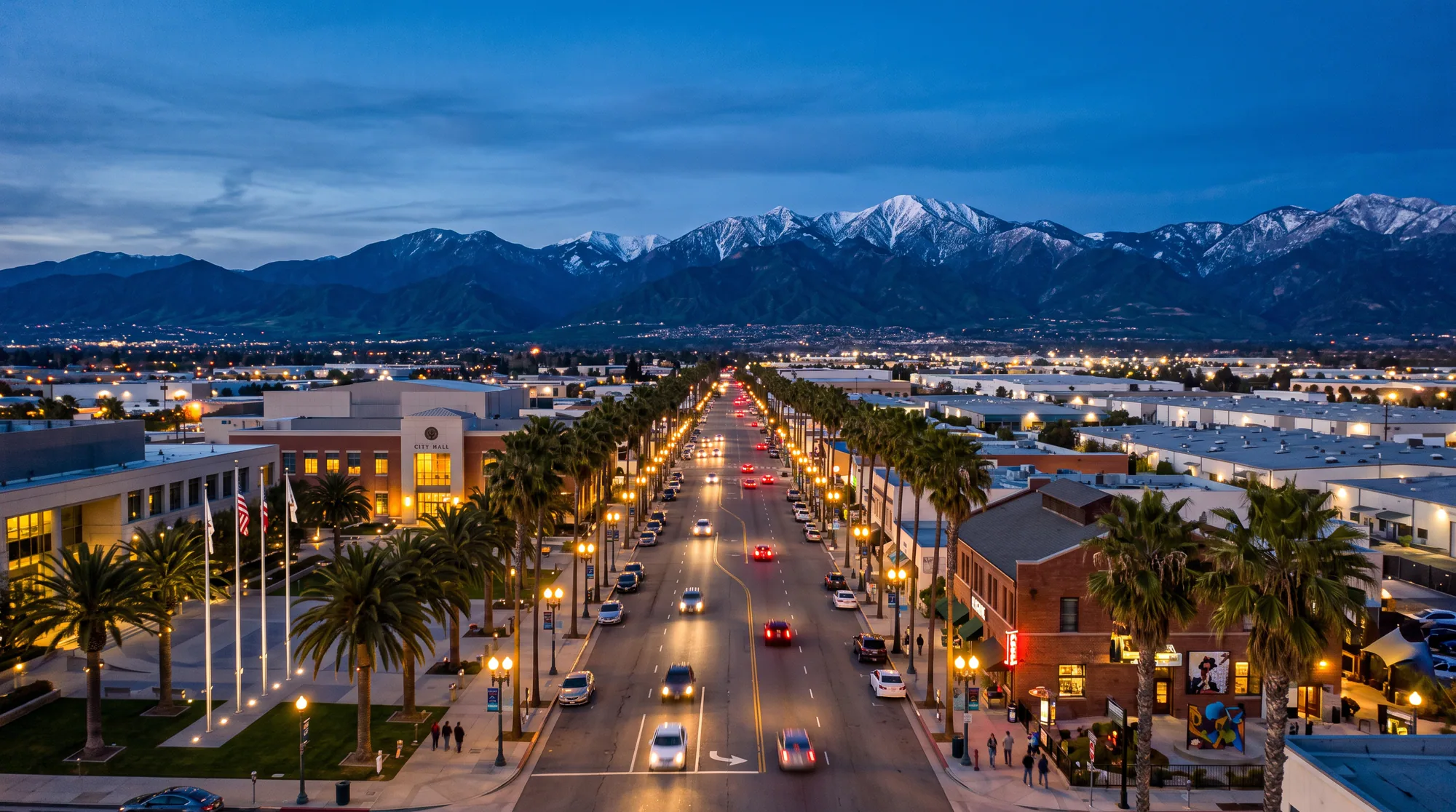
TempGuru · Fontana, CA · Local planning guide
A steel town that has already outlived two giant anchors, where today's event calendar runs through a rebuilt downtown and one very fast race morning.
Scroll. It gets specific.01The Ground Truth
Kaiser Steel's mill became a NASCAR superspeedway; the superspeedway is now being carved into warehouses, with turns 1 and 2 already gone and the promised short track stalled. What that history leaves behind is the point: Fontana's working event market is not out at the old oval, it is downtown, in a city-built arts district on Sierra Avenue, and on the first Saturday of June, when one of America's oldest half marathons pours 2,125 feet downhill out of the San Bernardino National Forest into the city's streets.
Auto Club Speedway is no longer an operating superspeedway: turns 1 and 2 and their parking lots have been replaced by two massive warehouses, remaining grandstands and garages sit untouched, and NASCAR's planned half-mile short-track conversion has stalled, with NASCAR leadership saying other sites take priority; the venue was originally built on the former Kaiser Steel mill site, whose successor California Steel Industries still operates on the property's southeast corner.
02The Map
Fontana's event infrastructure is a deliberate civic build, not an inheritance. The Steelworkers' Auditorium at 8437 Sierra Avenue, its name carrying the Kaiser era forward, seats 330 under theatrical lighting with a 33-foot stage, wing space, and a green room, the city's polished room for ceremonies, screenings, and performances. A short walk away, the Art Depot Gallery, a 1915 freight train depot on the Pacific Electric Trail in the Helen Putman Historical Plaza, headquarters the Fontana Arts program and hosts showcases, receptions, and workshops. Together with the library and plaza around them, they form a compact downtown district where most of the city's indoor calendar happens within two blocks.
The north end tells the other story. The Auto Club Speedway site, built in the 1990s on Kaiser Steel's old ground, is mid-transformation: two massive warehouses stand where turns 1 and 2 ran, the grandstands linger, and NASCAR's half-mile short-track plan has been publicly deprioritized. Until something reopens there, no staffing plan should be written against it, and this page does not.
"The mill became a speedway and the speedway is becoming warehouses. The event work that lasts here is the work the city built for itself downtown."Local planning note
Steelworkers' Auditorium, Sierra Avenue. Seating for 330 with a 33-by-15-foot stage, wings, dressing rooms, and house AV. Award nights and performances here are front-of-house work graded on polish, ushering, will-call, and cue discipline rather than crowd volume.
Art Depot Gallery, Helen Putman Historical Plaza. A 1915 freight depot turned gallery and Fontana Arts headquarters. Receptions and showcases run gallery-style: guest flow around installed work, catering in tight historic rooms, load-in through a building that predates loading docks.
The race-morning street grid. A course that starts at 3,800 feet in the San Bernardino National Forest and finishes downtown means closures roll down Sierra Avenue before sunrise. Support crews post in the dark and the whole operation wraps by early afternoon.
The speedway lands, north of the 10. Active construction ground. Warehouses occupy the old turns, remaining structures await a decision, and any future short-track events are unscheduled. Watch it; do not plan on it.
03What We Staff
Civic and arts programming leads: city ceremonies, performances, and screenings at the Steelworkers' Auditorium, with gallery receptions and cultural workshops at the Art Depot. Road-race and street events are the signature spike, led by the Fontana Days Run each June, pre-dawn course support, finish-line operations, and family festival crowds downtown.
Corporate and industrial events follow the logistics economy that now occupies the Kaiser-to-speedway corridor: safety milestones, grand openings, and workforce celebrations. Community festivals and seasonal events run through the parks system, and private and social bookings round out the weekends in the city's rentable rooms.
06The Rate
Published Fontana role rows are planning inputs, not a quote. Accepted terms control duties, the minimum shift, rate, and approved charges.
| Role | Rate | Min shift |
|---|---|---|
| General labor / setup | $38–$44/hr | 4 hrs |
| Registration | $38–$44/hr | 4 hrs |
| Guest services / ushers | $38–$44/hr | 4 hrs |
| Team leads / supervisors | $48–$54/hr | 4 hrs |
| Brand ambassadors | $54.50–$61.50/hr | 4 hrs |
| Specialized (bar, AV) | $58.50–$74.50/hr | 4 hrs |
09A Sample Plan
This illustrative scenario, not a historical TempGuru order, models Race-morning downtown festival at Fontana Civic Center plaza in Fontana, CA, 4,000 planned attendees, over 1 morning. The planning roster totals 23 workers across 8 General labor, 6 Guest services, 3 Registration, 4 Brand ambassadors, 2 Team leads.
23 billable across the site, split by zone rather than by hour: 2 leads anchor about 10 each, with floaters held back for heat and the gate surge. The map moves the crew, not the clock.
The Fontana Days Run began in 1955 and its half marathon drops 2,125 feet from start to finish out of the San Bernardino National Forest, a gradual downhill that the City of Fontana's own event page credits for the race's reputation as the fastest half marathon and one of the oldest in the United States; the 71st edition ran June 6, 2026, with the 72nd edition's registration opening in late October 2026.
The Steelworkers' Auditorium at 8437 Sierra Avenue, next to the Lewis Library and Technology Center in downtown Fontana, seats 330 with a stage 33 feet wide by 15 feet deep, wing space, a green room, dressing rooms, theatrical lighting, and on-site AV, the city's primary performing-arts and ceremony room.
The Art Depot Gallery at 16822 Spring Street serves as a Fontana Arts venue for artist showcases, receptions, workshops, and classes beside the Pacific Electric Trail in the Helen Putnam Historical Plaza.